






How Trackman combines radar and cameras for superior indoor accuracy
Trackman iO uses radar and high-speed cameras together — combining the strengths of each technology to deliver the most precise ball and club data indoors.
 Trackman Editorial Team
"Trackman is great outdoors, but camera systems are better indoors."
It's one of the most common assumptions in golf technology. It's also one of the biggest misconceptions. The launch monitor industry often frames indoor golf technology as a choice between radar and cameras. The argument is that camera systems are best indoors, while radar is best outdoors.
But according to Trackman CTO, Fredrik Tuxen, that way of thinking misses a much bigger point. The question isn't whether radar or cameras are better. It's which technology is best suited to measure each aspect of the golf shot.
Radar has strengths that cameras simply don't. Radar technology measures movement directly, making it exceptionally accurate for parameters like ball speed and club speed. Cameras, meanwhile, excel at capturing visual details with pixel-level precision.
So why does Trackman combine radar and cameras?
Because rather than forcing one technology to do everything, Trackman iO combines both. That means getting the benefits of cameras and radar — while minimizing the limitations of relying on either technology alone.
"At Trackman, we're not married to a single technology. We'll use whatever is best for the purpose,” says Tuxen. “By combining camera tracking with radar tracking, you get the best of both worlds and optimal accuracy. And that's precisely what Trackman iO accomplishes.”
The limits of camera-only technology
Camera technology is incredibly powerful. But like every technology, it has limitations.
Most camera-only launch monitors determine depth by using multiple cameras positioned at different angles. By comparing what each camera sees, they estimate where the ball or club is in three-dimensional space.
That approach works fine — but it becomes increasingly difficult as objects move farther away, and it introduces engineering challenges around camera spacing, stability and lighting.
As Tuxen explains, even something as simple as uneven illumination can change what each camera "sees".
But the point isn't that cameras are the wrong technology for indoor golf. Quite the opposite. Cameras are essential. The question is whether they should be expected to do everything on their own. Trackman's answer is no.
The result is far more than a spin-rate measurement. Trackman iO measures the complete three-dimensional orientation of the golf ball, including spin axis and gyro spin.
Trackman iO combines the cameras with Doppler radar. The cameras provide highly accurate angular measurements, while the radar contributes precise depth and speed information. Together, the two technologies complement one another, reducing the limitations either would face independently.
"We get the angles from the camera, and the radar essentially gives us the depth information. That's what gives us superior accuracy on all metrics. As long as you can swing your golf club, that's more than enough to determine the three-dimensional spin and the 3D orientation is within less than one degree,” says Tuxen.
Learn more about the Trackman iO specs
How Trackman iO automatically calibrates every shot
Accuracy isn't just about measuring the golf ball — it's about knowing what you're measuring it against.
Take the launch direction as an example. A launch direction of one degree left or right only has meaning if the system knows exactly where "straight" is. If that reference point is even slightly off, every shot is measured against the wrong target.
That's why Trackman iO automatically calibrates itself every time the system starts. The system projects a calibration pattern onto the impact screen and maps exactly where every pixel sits in three-dimensional space. From there, it establishes a precise zero point for launch direction, ensuring that "straight" is always truly straight. This avoids the accuracy pitfalls of manual alignment.
"You need to be very, very sure that it's calibrated — that what is zero is really zero," explains Tuxen. "Every single time you use the system, it will recalibrate this automatically, without any user interaction."
This approach removes one of the biggest sources of error in many indoor launch monitor setups: the user.
Some systems require players to place alignment sticks or manually define the target line. Even small inaccuracies in that process — or simply nudging the ball position during a session — can affect the reference point the system uses for every shot. Trackman iO eliminates that dependency by automating the entire process behind the scenes.
For the golfer, the result is simple. There's no need to think about calibration, alignment or setup. Whether it's a tour professional demanding precision to fractions of a degree or a family sharing a simulator at home, the system establishes the correct reference automatically, allowing players to focus entirely on their golf.
And calibration isn't the only area where Trackman iO is designed to remove human intervention from the measurement process.
The best measurement doesn't require markers
Another often overlooked difference between indoor launch monitors isn't how they measure the golf ball — it's what they need from the golfer before they can measure anything at all.
Many camera-based systems rely on reflective markers attached to the club or specially marked golf balls. These markers give the cameras reference points to track, allowing the system to calculate club movement and impact conditions.
Trackman iO takes a fundamentally different approach.
Because its cameras were designed with exceptionally high resolution, they don't need artificial reference points. Instead, they can identify the club itself — its grooves, score lines, toe, heel and other unique features — and track those directly throughout the swing.
“There's no need to have markers on the club in order to measure this,” says Tuxen. “If a system needs a marker, it’s because they don't have the resolution and can’t see the fine details that Trackman can.”
That difference isn't just about convenience — it also removes another potential source of measurement error.
Every time a marker is applied, it has to be positioned correctly. If it's even just slightly misaligned, the system is no longer measuring the club itself; it's measuring the position of the marker. Over the course of a practice session, markers can also shift, peel away or fall off entirely, requiring players or coaches to stop and start the setup process again.
As Tuxen explains:
"If you are only tracking the markers, then your measurement is referencing exactly where those markers are sitting. What if they're not positioned precisely? That's going to influence the accuracy you're getting."
For coaches working with multiple players, those interruptions quickly add up. Switching from one club to another can mean applying new markers. If one falls off after a few swings, the session pauses while it's replaced. It's friction that has little to do with golf and everything to do with the limitations of the technology.
Trackman iO eliminates that friction by recognizing the club exactly as it is. Its cameras capture details as small as the individual grooves on the clubface, allowing the system to determine club orientation and movement without modifying the equipment in any way. The same philosophy extends to the golf ball: players can use any ball, with no stickers, markings or special preparation required. All you need is enough space to swing your club.
For Trackman, that's about more than creating a cleaner user experience. It's a design philosophy. The golfer shouldn't have to adapt to the technology — the technology should adapt to the golfer.
As Tuxen puts it:
"We've developed the technology, so the user doesn’t have to deal with very technical things such as aligning this and that. It should just happen behind the curtain."
There's More to the Story
The idea that Trackman is a radar-only technology best suited for the outdoor game is just one of several misconceptions surrounding launch monitor technology.
That's why we'll be taking a closer look at some of the most common misconceptions surrounding launch monitor technology — from spin measurement and off-center strikes to measured versus calculated data — because every claim deserves to be examined against the same standard: evidence.
What they all have in common is the same underlying principle.
Trackman's technology isn't built around assumptions — it's built around measurement. Every hardware decision, every algorithm and every validation process is designed with one objective: to measure the golf shot as accurately as possible.
Every year, billions of golf shots are captured by Trackman systems around the world. Behind those numbers is a continuous process of engineering, scientific testing and validation against real-world data. It's why the world's best players, coaches, club fitters and equipment manufacturers rely on Trackman every day. (LINK: How Tour players use Trackman to build feel | Golf practice tips)
As Fredrik Tuxen puts it, Trackman is about using science — and the right technology — to measure the truth. Not camera-first. Not radar-first. Accuracy first.
"There's this misconception that Trackman is best outdoors, but not indoors. But actually, Trackman is best outdoors and indoors,” says Tuxen. “Whether it’s Trackman 4 or Trackman iO, the user doesn’t get the ‘Trackman truth’, they get the absolute truth.”
READ ALSO: Trackman iO — The best home golf simulator explained (LINK: https://www.trackman.com/blog/The-best-home-golf-simulator-Trackman-iO-explained)
FAQ 1. Does Trackman iO use radar or cameras?
Both. Trackman iO combines Doppler radar with high-speed camera technology rather than relying on either technology alone. The cameras provide highly accurate angular and visual measurements, while radar provides precise speed and depth information. The technologies are designed to complement one another, with each used for the measurements it performs best. Trackman's objective is measurement accuracy rather than commitment to one sensor technology.
2. Is Trackman only good outdoors?
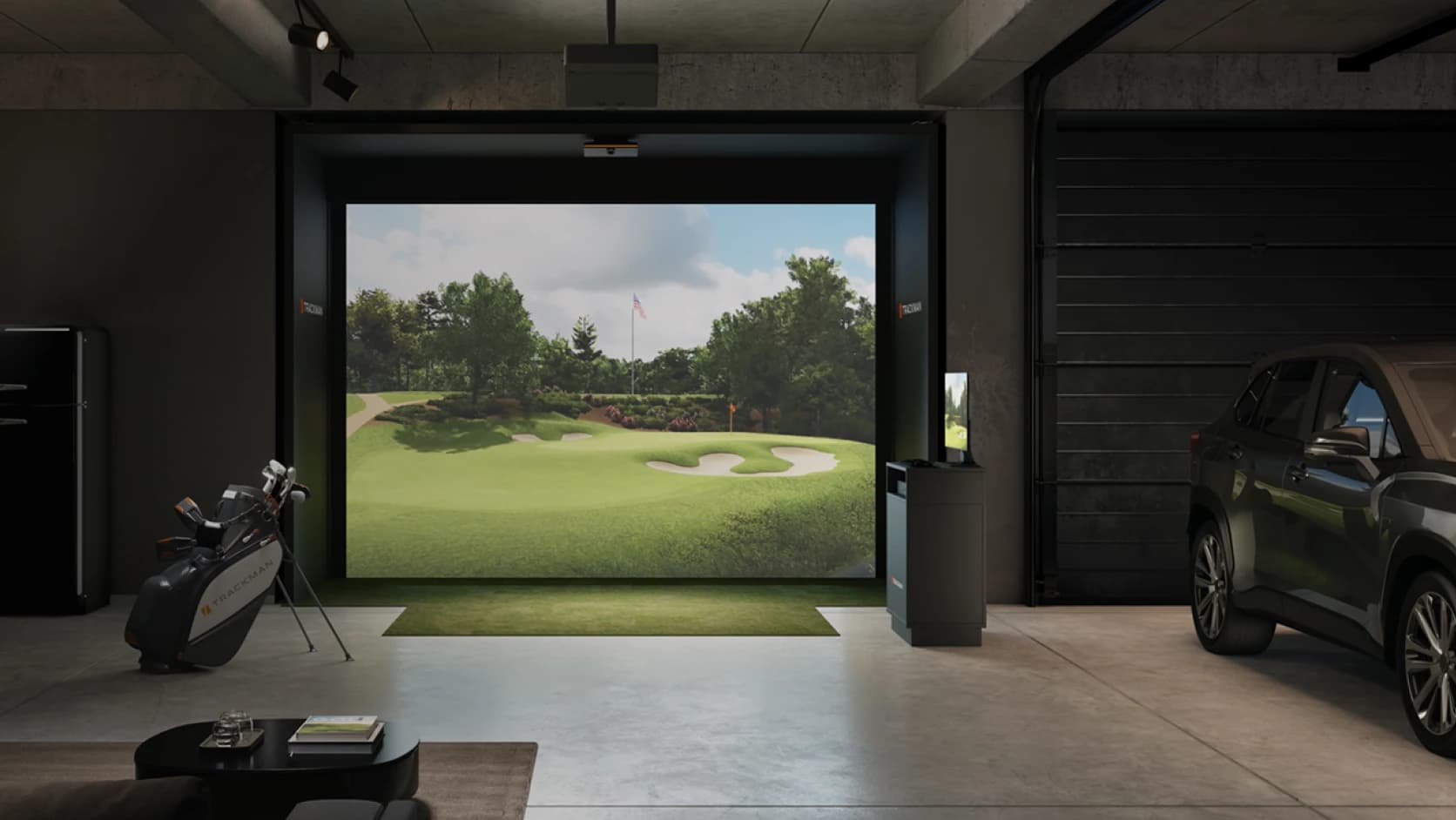
No. Trackman iO was specifically designed for indoor golf, combining radar, high-speed cameras and infrared illumination in a ceiling-mounted system. Trackman's approach is not to choose between "outdoor radar" and "indoor cameras," but to use the appropriate measurementtechnology for each aspect of the golf shot.
3. What are the limitations of camera-only launch monitors?
Cameras are extremely powerful and can capture visual information with pixel-level precision. However, camera-only systems typically need multiple cameras viewing an object from different angles to determine its position in three-dimensional space. This introduces engineering considerations involving depth, camera spacing, mechanical stability and lighting. Trackman iO instead combines cameras with radar so each technology can contribute the measurements it is best suited to provide.
4. Can Trackman iO measure spin accurately indoors?
Yes. Trackman iO uses its high-resolution, high-speed cameras to track how points on the golf ball move between frames. It measures not only spin rate but the complete three-dimensional orientation of the ball's spin, including spin axis and gyro spin. With Trackman iO, 3D spin orientation is measured to within less than one degree.
5. Does Trackman iO require club stickers, markers or special golf balls?
No. Trackman's broader design philosophy is that golfers shouldn't need to modify their equipment to generate measurement data. Trackman iO's high-resolution cameras can recognize details on the club itself, including grooves, score lines, the toe and heel. That allows the system to track the club without attaching artificial reference points to it. Removing markers also eliminates potential errors caused by stickers being incorrectly positioned, shifting or falling off. And players can use any ball without applying stickers, labels or other special markings.
6. How does Trackman iO calibrate indoors?
Trackman iO automatically recalibrates when the system starts. It projects a calibration pattern onto the impact screen and maps where the pixels are located in three-dimensional space. This establishes the system's zero point for launch direction without requiring the golfer to manually define the target line with alignment sticks or anything else that can lead to human error. Launch direction is only accurate if the system knows precisely where "straight" is. If that reference is slightly incorrect, subsequent measurements are referenced against an incorrect target line.
7. Why does Trackman iO use infrared lighting?
Trackman iO uses its own infrared illumination to create consistent lighting conditions for its high-speed cameras. This helps the system see the club and ball clearly and consistently, rather than relying on the ambient lighting in the simulator. The infrared lighting also insures that the golfer will not notice the ‘flashing’ of lighting system, since it happens outside the visual spectrum. Combined with radar providing depth information, this allows the cameras to focus on what they do best: capturing precise angles and visual details.